About Comments

Comments are enabled on all postings. Click a posting to find the comment box. Comments are moderated and appear after my review.

Sunday, 13 March 2022

BNHRMS Exhibition

After a two year hiatus, due to the pandemic, and with some excitement we visited the Basingstoke show once again. I was struck by how familiar everything was. Warring nations and pandemics lost from our minds with only the occasional face mask wearer reminding us of reality. 

This time we went in the afternoon to avoid excessive early morning crowds and lack of car parking. Afternoons are a much more civilised time to visit. 

The usual mix of high quality layouts and the same traders were on show. It seemed to me that there was, however, a subtle shift in layout presentations in so far as the intricate animations of cameo scenes that were becoming popular at the last few shows we visited - things like moving people and smoke effects were absent (unless I missed them). It was a return to traditional railway modelling. I did not even hear many sound effects.
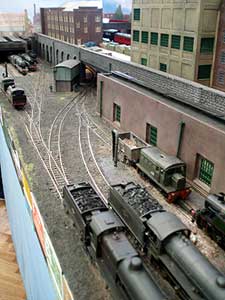
Three of the 20 odd layouts appealed most to me were:

Brankstone (00 gauge) was inspirational because it made optimal use of only about 2 metres length. It is a two level scheme where the foreground contained a locomotive depot and the upper level a separate end to end run. The loco depot is accessed from a gap in the retaining wall of the upper level and beneath this level was the fiddle yard. The upper level is a single track with storage sidings at each end hidden by the buildings. The operational interest is mainly  limited to the movement of locomotives in the yard whereas the upper level provides an unexpected appearance of a train appearing between the buildings on its run from nowhere to nowhere.

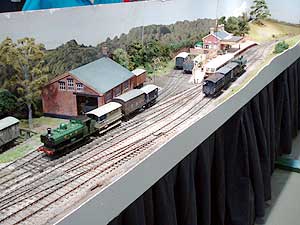
I seemed to think I had seen Bodmin (N gauge) somewhere before. Indeed it featured in another of my show reviews for Andover 2018. I'll repeat what I said then:

"Bodmin (N gaugestruck a chord with me as I visited the prototype. I remembered walking along the platform, chatting to the signalman at his box about the T9 languishing in the shed a little further down the yard. Now with a helicopter viewpoint I see the entire station complex with all the recognisable structures but in miniature."
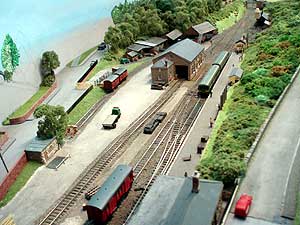

My best in show goes to Dillmouth (0 gauge). It captured perfectly the atmosphere of a country station aided by the best layout lighting I have ever seen. Halogen or LED?  miniature flood lights bathed the scene with the most natural bright summer sunlight.

Of the three items I wanted to purchase only one was found (solder). But, I did come away with a prize from the tombola (Metcalf stone sheets).

Also, said hi to Steve Flint, who was peddling his Peco publications. He remembered our layout that he voted best in show in 2014 and latter published in his magazine.
Sunday, 16 January 2022

Corgi 417 Revisited

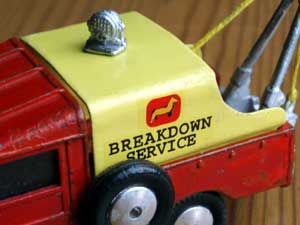
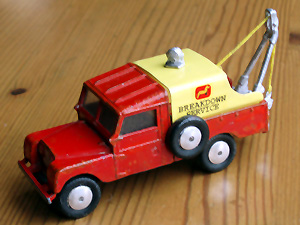
Back in March 2019 I posted my efforts in restoration of my Corgi 417 breakdown truck. What was not included was a replacement for the missing canopy as I did not find one in the market at the time. Now, nearly 3 years later, I wondered if I had some metal to fabricate one. A root through my box of bits revealed, surprisingly to me, a small piece of tin that was just about the right size. No idea where that originally came from.

The dimensions and placement of the canopy rear curves and roof searchlight position were determined by observation and scaling a photograph on ebay of an original truck. Much fiddling ensued to fold up the metal accurately.

Paint was sprayed using Revell enamel paint no.12 with a little white No. 4 mixed in to mimic the original shade, as best I could.

I searched ebay for searchlight and decals. These were found from this buyer, who also sells a replacement canopy!

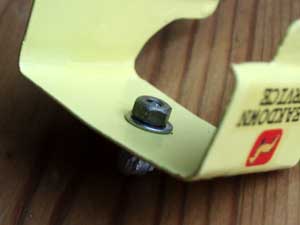
The searchlight has a spigot that pokes through the fixing hole but no clamp supplied to hold it in place. I used a nut and reduced the diameter of the spigot with a file until I could screw the nut on, making its own thread in the soft white metal. Enough slack was left so the searchlight can swivel.


The truck red paintwork was quite badly chipped. Since it now has a new, pristene canopy I decided to touch up the chips with red paint. Not perfect but looks better than before


Tuesday, 21 December 2021

DIY Refurbishment of Zero 1 Keypad

The Hornby Zero 1 is the simplest and cheapest DCC system to operate, albeit with limited functionality. Second hand controllers and chips are available from ebay. The biggest downside is the loco chip board that is too big to fit into some modern tank locomotives and it does require some ingenuity to fit into some larger modern locos.

The system was launched by Hornby in the 1980s and after 40 odd years it is no surprise that the keypad fails. It is the weakest part of the controller design. The failure is due to the carbon tips of the elastomer keypad keys wearing away. Happily it is easily fixed without the need for electronics knowledge or great expense.

Sorry, no pictures.

  1. Remove from power source
  2. Drill out the 10 rivets holding the unit top to base
  3. Lift off the top starting at the rear, rotating to the front taking care not to damage wires between base and top
  4. Remove the small phillips screws that hold the keyboard in place
  5. Gently easy back the two keypad front retaining clips to release the keyboard and fold away to reveal the elastomer keypad
  6. If the button circuit areas on the printed circuit board look dirty then clean with Isopropyl Alcohol and if still dirty use a fibreglass rubber or scalpel taking care not to destroy the circuit tracks
  7. Brush away any detritus on the black pads of the elastomer keypad with a dry paintbush.
  8. Take some aluminium kitchen foil and a paper hole punch that has a 5mm punch and punch out 17 circles. If the punch is larger than 5mm then cut squares instead that are a little larger than the black pads of the elastomer keypad
  9. Test fit an aluminuim pad over a black pad to ensure it is wholly contained within the well and below the top surface
  10. Glue the aluminium pad on top of the carbon pad with a small drop of super glue and check it has set, i.e. does not slide off the pad
  11. Press lightly on the fixed aluminium so that it slightly wraps down the side of the carbon pad
  12. Repeat for all buttons
  13. Refit the keyboard and top to base. The top should be located at the front first and then rotated over the rear
  14. Since the unit was held together with rivets it is not be possible to fix the top to base easily. You might try a couple of small wood screws screwed into the palstic holes.


Related Posts Plugin for WordPress, Blogger...